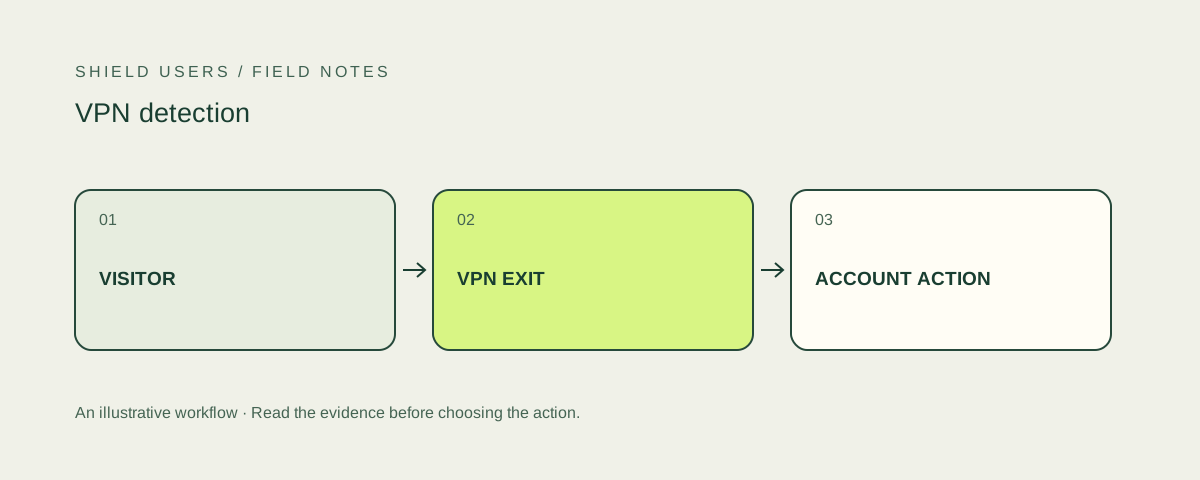
VPN detection identifies a connection that appears to use a virtual private network. The result is useful context for registration, login and sensitive account actions. It does not establish whether the account belongs to the person using it, and it does not make a privacy-conscious customer abusive.
Start with the action you protect
A new account claiming a high-value promotion needs different handling from a returning customer reading a help page. Write down the protected action and the cost of getting it wrong before choosing a detector. An IP flag can influence a sensitive action without turning ordinary browsing into an authentication challenge.
For a purchase or payout, combine connection context with authentication and account history. For a signup, examine repeated device use and attempts to claim the same benefit. This keeps the decision tied to an observable action.
Compare two detection approaches
An IP lookup classifies the public address. A browser-integrated product can add device and connection-consistency signals. Those approaches answer overlapping questions, but an IP-only response cannot establish whether the same browser returned under a new address.
IP APIs suit an existing backend that needs connection enrichment. Combined platforms suit teams that also need identity and account events. Use the tool comparison below to shortlist by output and collection requirements, then read the full integration review.
Treat privacy services as their own cohort
Corporate VPNs, commercial privacy VPNs and Apple Private Relay can appear in otherwise ordinary customer journeys. Keep their completion and support outcomes separate from confirmed abusive activity. A high challenge rate on one privacy cohort can expose a policy problem.
Apple publishes guidance for services receiving Private Relay traffic. Use that service context with authentication and history instead of treating all masked exits as equivalent. Route uncertain observations to a reversible step-up action before a permanent restriction.
Evaluate a detector on your traffic
Build a small labeled pilot with known test connections and legitimate users who consent to participate. Record when the check ran, which signal was present and what happened to the account action. Review completed checks separately from errors or incomplete collection.
Measure both the harmful activity that got through and the genuine users who were challenged. A connection flag that looks useful in a demo may be too disruptive for your particular audience. Keep a way to revise the action without changing the evidence record.
Tools to consider for vpn detection
Read the full scope, access terms and pilot questions before integrating.
 Editor’s Choice
ShieldLabs
A combined view of visitors, users, devices and IPs, with ready-made account abuse detections and traffic quality analytics.
Consider for Teams that want identity, masking signals and account-level risk in one product.
Read the review
IPQualityScore
A direct way to add IP-level fraud information to an existing account workflow, with separate products for device and other identity data.
Consider for Teams adding a focused IP reputation check to an application they already operate.
Read the reviewIPinfo
Network enrichment for teams that need IP, ASN, location and privacy-service context alongside data they already collect.
Consider for Applications with their own device and account logic that need structured network information.
Read the reviewSources and further reading
Product and technical sources reviewed October 21, 2026.
FAQ
Can a website always detect a VPN?
No detector should be treated as universal proof. Coverage varies with the network, collection method, signal availability and connection changes.
Should I block every VPN user?
A VPN is a connection characteristic. Choose the action using authentication, account history, device context and the sensitivity of the request.
Is Private Relay the same as a VPN?
It is a distinct privacy service with its own behavior. Keep it separately identified when your data source supports that distinction.