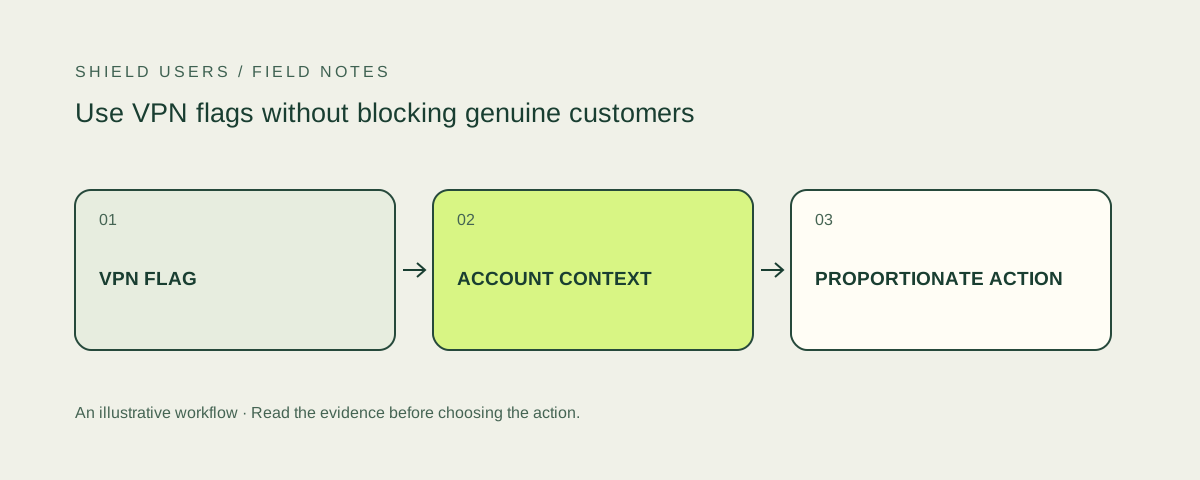
An ordinary customer can connect through a work VPN, a privacy service or a shared network. If your login policy treats that connection as proof of account abuse, the policy can create the problem it was meant to prevent: customers lose access to an account they own. Apple’s Private Relay guidance is a useful reminder that privacy traffic needs its own handling.
Start with the action, then examine the signal.
Store the connection observation separately from the account decision. Identify what the customer is attempting and choose the least disruptive check that protects that action. Review whether the outcome was correct afterward.
Start with a decision table
A decision table makes the policy reviewable before anyone writes a permanent IP block. The following examples are design scenarios, not measured customer outcomes or mandatory thresholds.
| Observed situation | Additional evidence to inspect | Possible handling |
|---|---|---|
| Known device, ordinary account activity, VPN exit | Recent successful authentication and account history | Continue and retain the observation |
| New environment changing recovery settings | Authentication strength and the ownership of the recovery route | Reauthenticate before the change |
| Several accounts claiming the same restricted benefit | Device links, claim history and benefit eligibility | Hold that claim for review |
| Check failed or collection incomplete | Integration status and the sensitivity of the action | Use an explicit fallback, then retry or step up |
These rows intentionally avoid a universal rule that a particular network type must be blocked. The same connection can appear in several legitimate and abusive workflows. The account action gives the evidence its practical meaning.
Keep an observation record you can explain
Store the observed address, time, source, response or request identifier and relevant named fields. Keep your application’s action in a separate record. If the policy changes later, you should still be able to reconstruct why the original decision happened.
An IP lookup result and a combined browser check have different scopes. The former describes the submitted address. The latter can add device continuity or consistency evidence. The VPN detection hub explains how to compare those integration shapes without treating them as interchangeable.
Make the step-up path complete
A step-up check should preserve the customer’s intended action. Explain what is required, handle success and failure, and give the user a way back if the signal was incorrect. An unexplained loop that repeatedly asks for the same verification is an access failure, even if the detector returned its field correctly.
For sensitive account changes, consider the authentication requirements in OWASP’s authentication guidance. Avoid treating a VPN flag as a replacement for proof of account control. Network context and authentication answer different questions.
Measure the cost to the genuine customer
Track the completion rate of challenged actions, repeat challenges on the same account, support contacts and restrictions reversed after review. Break the results down by legitimate network cohort. A blended completion rate can hide a problem affecting travelers or corporate VPN users.
Keep confirmed abuse labels distinct from your original signal. If a customer appeal establishes legitimate use, preserve both facts: the detector observed a VPN and the account action was permitted. You can improve the handling without pretending the original network observation disappeared.
Choose the integration around the missing evidence
If you already operate account and device history, an IP specialist may supply the missing connection field. If repeated signups across changing exits are the problem, a platform with device and account context may save integration work. Compare the tools by output, collection requirements and access terms before comparing headline prices.
The useful end state is a clear explanation of the protected action, the evidence you used and the route a legitimate customer can take to finish it. That is a more durable control than a growing list of rejected IP addresses.
Sources and further reading
Product and technical sources reviewed October 21, 2026.
FAQ
How accurate are VPN and proxy detection tools?
Accuracy depends on the traffic cohort, the collection method and what counts as a correct result. Evaluate network classification separately from the outcome of the account action.
How can SaaS platforms detect suspicious account access from VPNs?
Combine the VPN observation with device continuity, authentication and the account’s recent actions. Apply a step-up check to the sensitive action when the combined evidence warrants it.