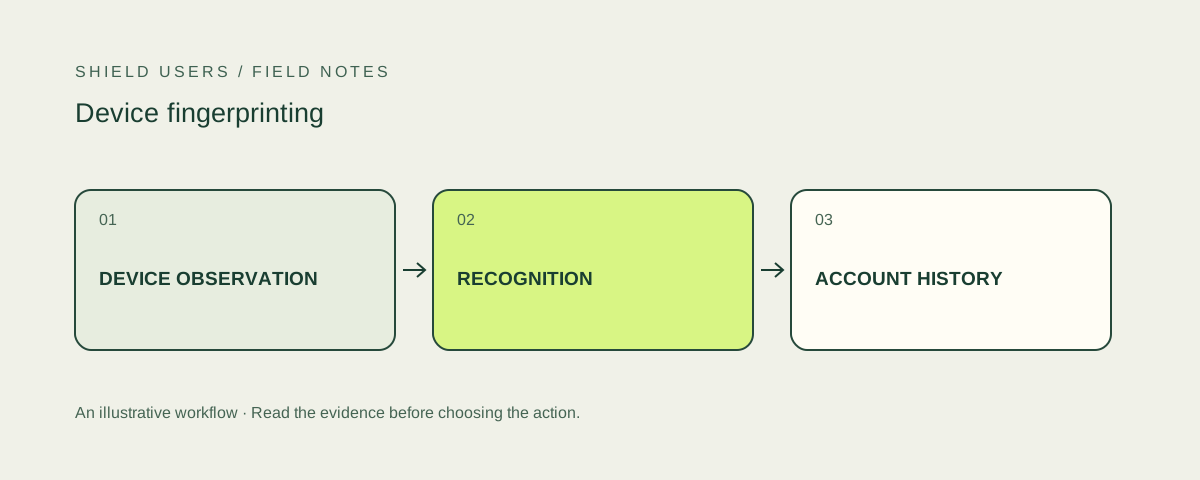
Device fingerprinting uses observed properties of a browser or device to help recognize an environment across interactions. Its role in user protection is continuity: linking useful context when cookies or network addresses change. It is not proof of a person’s legal identity or authority over an account.
Model the entities before installing an SDK
Keep your authenticated user ID separate from the device or visitor identifier returned by a provider. One user may legitimately use several devices; a shared device may legitimately serve several users.
Write down which identifier is stable, which can change, and which application events bind them. Store the provider’s observation or request identifier as well. This gives an investigator a traceable event instead of an unexplained list of linked accounts.
Collect at important transitions
A page-load check and a check before a sensitive account change have different relevance. Identify where the observation will be available in time and how the backend associates it with the protected action.
Retrieve or verify the result through a trusted server path. Do not let the browser submit an arbitrary favorable score as the only evidence. Document how stale, replayed or missing results are handled in your application.
Expect a changing environment
Browser versions, privacy features, device updates and collection restrictions affect the observations available to a provider. Different products use different definitions of identity and confidence.
Evaluate continuity and false links separately. A detector that frequently creates a new identifier can lose useful history; one that merges unrelated environments can create incorrect account relationships. Both errors matter when the result influences access.
Choose the operational fit
Fingerprint offers web and native mobile paths with a broad signals catalog. SEON places device observations inside a configurable fraud workflow. ShieldLabs combines device identity with network risk and ready-made account events.
The right comparison starts with the output you need, the platform you support and the investigation workflow you can maintain. Review free-plan coverage separately from production signal access and data retention.
Tools to consider for device fingerprinting
Read the full scope, access terms and pilot questions before integrating.
 Editor’s Choice
ShieldLabs
A combined view of visitors, users, devices and IPs, with ready-made account abuse detections and traffic quality analytics.
Consider for Teams that want identity, masking signals and account-level risk in one product.
Read the review
Fingerprint
A device identification platform with a broad Smart Signals catalog for browser and native mobile environments.
Consider for Engineering teams building a device-centered workflow across web and mobile.
Read the review
SEON
A configurable fraud platform combining device, network and additional identity-related data in a broader investigation workflow.
Consider for Risk teams that need to combine multiple data sources and maintain their own rules.
Read the reviewSources and further reading
Product and technical sources reviewed October 21, 2026.
FAQ
Is a device ID the same as a user ID?
No. A user ID identifies an application account. A device or visitor ID describes an observed environment using the provider’s identity model.
Can several legitimate users share a device?
Yes. Shared households, support workflows and managed environments can create many-to-one relationships.
Does fingerprinting replace authentication?
No. Recognition is a risk and continuity input. Passwords, passkeys, recovery and session controls have separate roles.