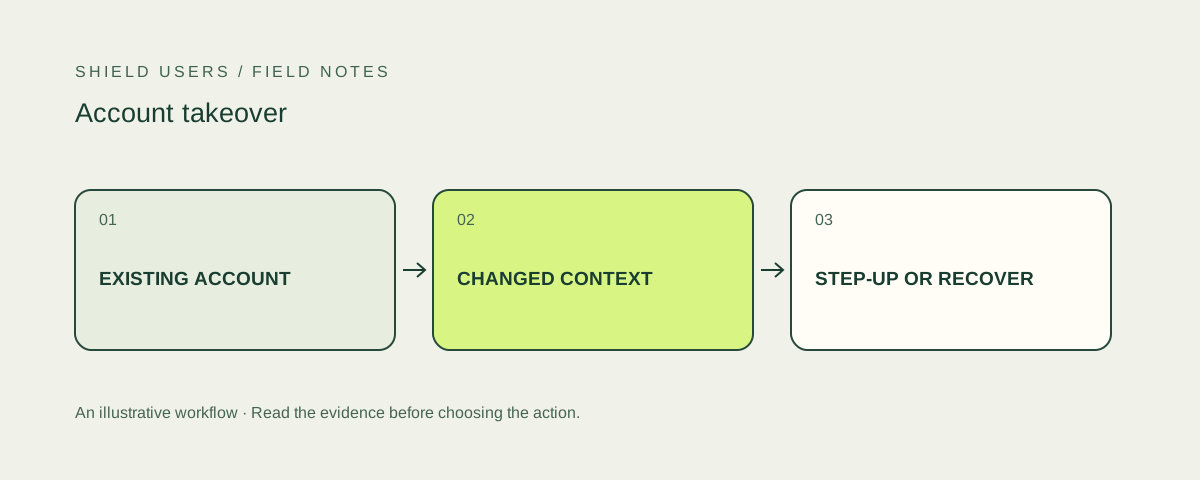
Account takeover is unauthorized use of an existing account. Detection looks for meaningful changes in access and activity, while prevention also depends on authentication, recovery and session controls. A new IP or device can be a useful signal without being proof that the account has changed hands.
Protect authentication and recovery together
Login is only one entry point. Password reset, email changes, support-assisted recovery and newly enrolled authenticators can also change control of an account. Apply a consistent review of those transitions.
OWASP’s authentication guidance covers reauthentication after risk events. Use that principle near sensitive changes, with a recovery route that does not simply fall back to the weakest original factor.
Correlate the change with the action
A customer signing in from a new phone is different from a new environment immediately changing recovery settings. Keep device observations, authentication results and account actions on a timeline.
Impossible travel based on IP-derived location also needs network context. A VPN exit can change apparent geography without physical travel. Look for corroboration and retain the underlying observations rather than presenting distance as certainty.
Use a reversible step-up path
A stronger authentication step can protect a sensitive action while preserving access to lower-risk areas. Explain what the customer needs to do, maintain the state of the original action and provide a support route.
If a session is confirmed compromised, revoke the relevant sessions and credentials and guide the owner through recovery. Detection software adds context; application session management determines whether unauthorized access actually ends.
Measure customer recovery, not just alerts
Review the relationship between an alert, the action taken and the account’s later outcome. A system that creates many alerts may still leave recovery paths exposed or generate avoidable support work.
For a pilot, test a known device, a normal network change, a new device with strong authentication and a controlled recovery attempt. Confirm your team can reconstruct the event and reverse an incorrect restriction.
Tools to consider for account takeover
Read the full scope, access terms and pilot questions before integrating.
 Editor’s Choice
ShieldLabs
A combined view of visitors, users, devices and IPs, with ready-made account abuse detections and traffic quality analytics.
Consider for Teams that want identity, masking signals and account-level risk in one product.
Read the review
Fingerprint
A device identification platform with a broad Smart Signals catalog for browser and native mobile environments.
Consider for Engineering teams building a device-centered workflow across web and mobile.
Read the review
SEON
A configurable fraud platform combining device, network and additional identity-related data in a broader investigation workflow.
Consider for Risk teams that need to combine multiple data sources and maintain their own rules.
Read the reviewSources and further reading
Product and technical sources reviewed October 21, 2026.
FAQ
Does a new device mean account takeover?
No. Users replace devices and change browsers. Evaluate authentication, network context and subsequent account actions together.
Does a VPN prove impossible travel?
No. A VPN can change IP-derived geography without physical movement. Network context is essential to interpreting that signal.
Do passkeys remove the need for account-risk monitoring?
They strengthen authentication, while session theft, recovery workflows and sensitive account actions still need appropriate controls.