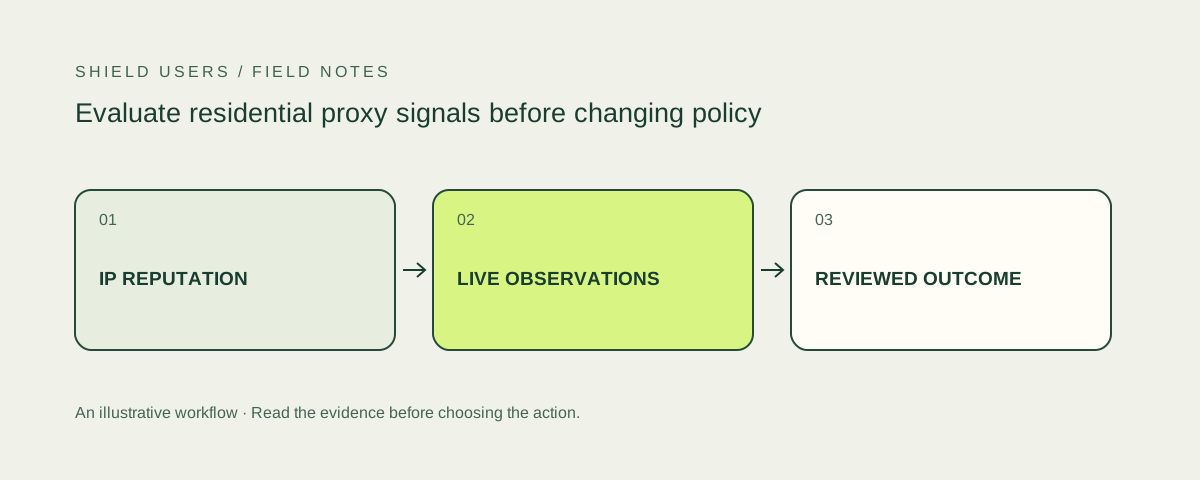
A residential IP label tells you something about the address space. It does not establish whether a request was relayed or whether an account action is permitted. SEON’s residential proxy documentation distinguishes IP reputation from SDK-based network analysis, a distinction worth preserving in a purchasing decision.
Start the evaluation by writing down which observation each product supplies. Record what the provider checked, when it checked it and which conclusion the evidence supports.
Keep the connection observation specific.
Verify the address at your application boundary
An application behind a CDN does not necessarily receive the visitor’s public IP as the immediate peer address. Before testing a lookup provider, document the trusted infrastructure and how it supplies the client address.
Do not accept an arbitrary forwarding value simply because a browser sent it. MDN’s Forwarded reference describes information added by proxies; your infrastructure still needs a trust policy for that information. The correct rule depends on the deployment, so test it with your CDN and origin configuration.
Separate four evidence layers
| Layer | What it contributes | What it does not establish alone |
|---|---|---|
| IP and ASN context | Network owner, address classification and location context | The person operating an account |
| Proxy observation | Evidence that the current connection is relayed | Whether a specific action is abusive |
| Device continuity | A relationship with earlier observed environments | Legal identity or account ownership |
| Account action history | Repeated claims, access changes and policy-relevant behavior | A universal verdict for every later action |
Keep these layers visible in an investigation. If the product combines them into a score, retain the named reasons too. That lets support distinguish an incorrect policy from an incorrect observation.
Treat missing and incomplete as actual states
A network check may not complete in the time available during a signup. SDK collection and a server lookup can also fail for different reasons. Represent those states explicitly rather than converting every missing field into false.
Use a data contract such as complete, incomplete, unavailable or error, along with the action timestamp. Those are example application states, not a vendor’s literal response schema. Map the chosen provider’s fields into your contract and preserve the raw request identifier for investigation.
Construct a useful pilot
Use connections and accounts your team controls, plus ordinary traffic you are authorized to evaluate. Include broadband, mobile carrier, corporate exits, commercial VPNs and your known test proxies. Keep the cohorts separate even if the total sample is small.
Record the configured collection window, integration version and cache age. Compare whether a repeated account action can be linked across a changed address, not merely whether one isolated lookup produced the expected label. Review the handling of ordinary users from shared networks.
Watch the cache, not just the provider
A stale application cache can preserve a classification after its relevance changes. The provider may have updated its data while your policy still acts on yesterday’s answer. Document the maximum age acceptable for each action and recheck when that limit is reached.
The proxycheck.io API reference exposes detection-history concepts that make this issue tangible. Whether or not you choose that provider, record freshness as part of the integration rather than assuming it from the word real-time.
Turn evidence into a reversible action
The first production use can be observation or a step-up on a sensitive benefit. Choose a route that lets your team inspect the result, respond to a legitimate appeal and revise a rule. A proxy signal can help prioritize a case without becoming the entire case.
For purchasing, use the proxy detection hub and the tool reviews. Match the required evidence to the product’s actual collection path, then compare its cost at the daily and monthly volumes your traffic produces.
Sources and further reading
Product and technical sources reviewed October 21, 2026.
FAQ
Why are residential proxies harder to detect than VPNs?
Residential exits can use ordinary ISP address space, which limits what a hosting or ASN classification alone can establish. Additional documented connection observations may be needed.
How can companies reduce false positives in proxy detection?
Validate the client IP source, separate network cohorts, retain the reasons and collection status, and review genuine-user outcomes before applying broad restrictions.